

Canadian Researcher Guide · 2026
Retatrutide (Reta) in Canada: The Triple Agonist Peptide — Research, Results & Where to Buy
Retatrutide (LY3437943) is the most potent weight loss compound to have produced Phase 3 clinical trial data. Where Semaglutide averages ~15% body weight loss and Tirzepatide ~20–22%, the TRIUMPH-4 Phase 3 trial reported an average of 28.7% body weight reduction over 68 weeks — results approaching bariatric surgery outcomes. This guide covers exactly how Retatrutide works, what the trial data shows, how it compares to existing options, and where to buy Retatrutide in Canada for research purposes.
What Is Retatrutide?
Retatrutide in Canada is known by its research designation LY3437943 — a weekly injectable peptide being developed by Eli Lilly (the same company behind Mounjaro/Tirzepatide). It belongs to the GLP-1 receptor agonist class but differs from every predecessor in one fundamental way: it’s a triple agonist, targeting three hormone receptors simultaneously rather than one or two.
Current approved weight loss medications target either one receptor (GLP-1 alone, like Semaglutide) or two receptors (GLP-1 + GIP, like Tirzepatide). Each additional receptor has historically produced greater weight loss in clinical trials. Retatrutide adds a third — the glucagon receptor — and the Phase 3 results confirm that the incremental effect is again meaningful. It is currently in the TRIUMPH Phase 3 clinical trial program, which has enrolled more than 5,800 participants across multiple conditions including obesity, type 2 diabetes, obstructive sleep apnea, and knee osteoarthritis.
How Retatrutide Works: The Three Receptor Mechanism
To understand why Retatrutide produces greater weight loss than any predecessor, it helps to see exactly what each of its three receptor targets contributes:
GLP-1 (Glucagon-Like Peptide-1)
GLP-1 is the receptor targeted by Semaglutide (Ozempic, Wegovy). Activating it slows gastric emptying, reduces appetite, increases satiety after meals, and stabilises blood sugar by stimulating insulin release. It essentially functions as a brake on caloric intake — making food feel satisfying sooner and for longer. This receptor alone drives the ~15% weight loss seen with Semaglutide.
GIP (Glucose-Dependent Insulinotropic Polypeptide)
GIP is the second receptor, also targeted by Tirzepatide. It works alongside GLP-1 to further improve insulin sensitivity and enhance fat metabolism. Importantly, research suggests GIP activation may also buffer some of the nausea associated with high-dose GLP-1 therapy — potentially allowing more aggressive dosing without proportionally worse tolerability. The addition of GIP is what pushes Tirzepatide’s average weight loss to ~20–22%.
Glucagon — Where Retatrutide Breaks New Ground
The glucagon receptor is what distinguishes Retatrutide from everything that came before it. While GLP-1 and GIP primarily work by reducing caloric intake, glucagon activation increases how much energy the body burns — through two mechanisms: lipolysis (breaking down stored fat for fuel) and thermogenesis (increasing metabolic rate through heat production). According to a review published in Frontiers in Endocrinology, glucagon receptor activation can substantially elevate energy expenditure beyond baseline metabolic rate.
In plain terms: GLP-1 and GIP reduce the calories going in. Glucagon helps burn through the calories already stored. Retatrutide addresses both sides of the energy equation simultaneously — which is why its weight loss results outperform compounds that only reduce intake.
The Research: What the Clinical Trials Show
Phase 3 — TRIUMPH-4 Trial: 28.7% Average Body Weight Loss
The most striking data comes from the TRIUMPH-4 Phase 3 trial, which studied 445 adults with obesity and knee osteoarthritis. Over 68 weeks, participants on the highest dose (12 mg weekly) lost an average of 28.7% of their body weight — approximately 71 lbs on average. This positions Retatrutide’s efficacy firmly in the territory previously achievable only through bariatric surgery (typically 25–30% weight loss).
Phase 2 — Weight Loss Trajectory Still Climbing at 48 Weeks
An important finding from the earlier Phase 2 trial published in the New England Journal of Medicine: weight loss had not significantly slowed at 48 weeks, suggesting longer treatment periods may produce even greater results. The progression from 24.2% in that Phase 2 trial to 28.7% in Phase 3 at 68 weeks supports this. No existing weight loss medication has shown this kind of continuing trajectory without a clear plateau.
Fatty Liver Disease Resolution
In Phase 2 trials, over 85% of participants on the highest doses achieved complete resolution of liver fat accumulation (hepatic steatosis). For context, Semaglutide’s hepatic fat data showed ~37% relative reduction in the REDUCE trial — Retatrutide’s 85% complete resolution rate represents a substantial leap in efficacy for metabolic dysfunction-associated steatohepatitis (MASH), a condition affecting a growing proportion of Canadians.
Osteoarthritis Pain Reduction
The TRIUMPH-4 trial also found significant reductions in knee pain scores alongside the weight loss. More than 1 in 8 treated patients reported being completely pain-free by the end of the study — a meaningful outcome explained by the combination of reduced mechanical load on joints from substantial weight loss and the potential anti-inflammatory effects of the treatment itself.
How Retatrutide Compares to Other Weight Loss Peptides
| Compound | Receptors Targeted | Average Weight Loss | Approval Status (Canada) |
|---|---|---|---|
| Semaglutide (Wegovy) | GLP-1 | ~15% | Approved (Wegovy) |
| Tirzepatide (Zepbound) | GLP-1 + GIP | ~20–22% | Approved (Mounjaro) |
| Retatrutide | GLP-1 + GIP + Glucagon | ~28.7% | Phase 3 trials (not yet approved) |
For a 250 lb patient, the difference between Tirzepatide and Retatrutide translates to roughly an additional 16 lbs of weight loss. For patients with severe obesity where even a 20% reduction leaves significant metabolic risk, that incremental gap becomes clinically meaningful. Retatrutide is also the only compound in this class approaching the weight loss outcomes that have historically required surgical intervention.
Side Effects and Safety Profile
Like all GLP-1 receptor agonists, Retatrutide’s most common side effects are gastrointestinal: nausea, vomiting, diarrhea, and constipation. These are dose-dependent and most pronounced during the early weeks of dose escalation. The TRIUMPH trials used a “start low, go slow” approach — beginning at 2 mg and escalating every four weeks — to manage tolerability during the ramp-up phase.
Side Effects Specific to the Glucagon Component
The glucagon receptor activation introduces two side effects not typically seen with GLP-1-only or dual-agonist medications:
Dysesthesia (skin sensitivity) — In the TRIUMPH-4 trial, roughly 1 in 5 participants on the highest dose reported dysesthesia — an abnormal sense of touch that can manifest as numbness, tingling, or an unusual skin sensitivity sometimes described as a sunburn-like tenderness without visible rash. These events were generally mild and rarely led to treatment discontinuation, but this is a new signal not observed in Phase 2 and will be closely monitored in ongoing studies.
Heart rate increases — Clinical trials found a dose-dependent increase in resting heart rate, peaking around 24 weeks before gradually declining. GLP-1 medications like Semaglutide and Tirzepatide also raise heart rate slightly (2–4 bpm), but Retatrutide’s glucagon component may push this somewhat higher. The ongoing TRIUMPH-OUTCOMES cardiovascular trial will determine whether this signal translates into meaningful clinical risk, or whether the substantial cardiovascular benefits of ~29% weight loss outweigh it.
Retatrutide (6mg) — Research Grade, Canadian Manufactured
Research Chemical · Canadian Manufactured
Retatrutide (6mg)
Triple GLP-1 / GIP / Glucagon Agonist · >99% Purity · Ships Same-Day Canada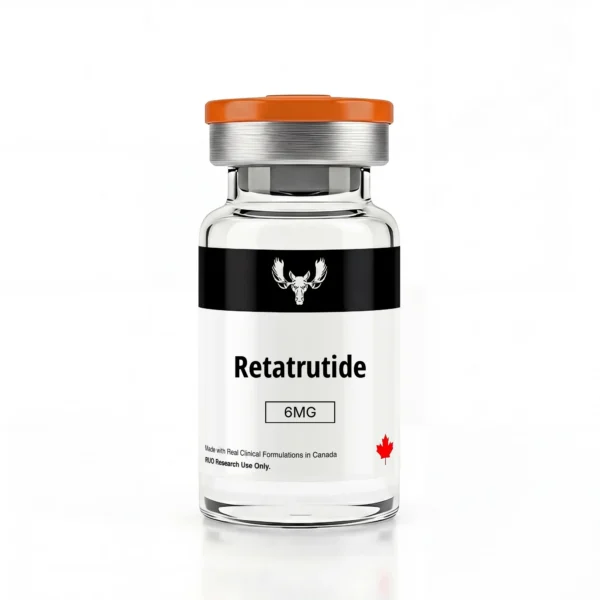
Our Retatrutide (6mg) is manufactured in Canada, verified at >99% purity by HPLC and mass spectrometry, and ships same-day across Canada. Each vial contains 6mg of lyophilised Retatrutide powder, providing a meaningful quantity for research protocols exploring this compound’s triple-agonist pharmacology.
At 6mg per vial, this provides sufficient material for researchers to study the compound’s mechanisms across a range of dose points — from the 2mg starting dose used in the TRIUMPH titration protocol up to mid-range doses. The lyophilised format ensures stability during storage; once reconstituted with bacteriostatic water, the solution should be kept refrigerated. Use our Peptide Dosage Calculator for precise reconstitution volumes and injection unit calculations.
Retatrutide is sold strictly for research and laboratory use. It is not approved by Health Canada for therapeutic use and should not be used for human consumption. Given the clinical interest in its triple-agonist mechanism — and the gap between its Phase 3 data and currently available compounds — it represents one of the most scientifically relevant weight loss peptides available to researchers studying GLP-1 pharmacology, glucagon receptor biology, or metabolic disease in Canada.
Shop Retatrutide (6mg) →Retatrutide vs. Semaglutide vs. Tirzepatide: Choosing for Research
For researchers in Canada studying GLP-1 axis pharmacology or metabolic disease, the choice between these three compounds depends on what receptor pathway is being studied:
Semaglutide isolates the GLP-1 receptor pathway cleanly — the simplest single-variable research model for GLP-1 biology. Tirzepatide adds GIP receptor activation, enabling research into the GLP-1/GIP synergy and dual-receptor metabolic effects. Retatrutide adds glucagon receptor activation on top — enabling research into the full triple-receptor pharmacology, thermogenesis mechanisms, lipolysis from glucagon agonism, and the interaction between glucagon and the GLP-1/GIP system.
All three are available from Boss Peptides. For weight loss biology research specifically, Retatrutide’s triple mechanism offers the broadest receptor coverage and the most potent metabolic effect, while Semaglutide and Tirzepatide provide cleaner isolation of their respective receptor subsets.
Frequently Asked Questions About Retatrutide in Canada
What is Retatrutide?
Retatrutide (LY3437943) is a weekly injectable peptide developed by Eli Lilly. It is a triple agonist targeting GLP-1, GIP, and glucagon receptors simultaneously — making it the most potent weight loss compound to have produced Phase 3 clinical trial data, with an average of 28.7% body weight reduction over 68 weeks in the TRIUMPH-4 trial.
Is Retatrutide approved in Canada?
Not yet. As of 2026, Retatrutide is in Phase 3 clinical trials and has not been submitted to Health Canada for approval. Based on current trial timelines, a Health Canada submission could occur in late 2026 or early 2027, with potential approval in mid-to-late 2027. It is currently available in Canada as a research chemical only.
How does Retatrutide compare to Ozempic and Mounjaro?
Semaglutide (Ozempic/Wegovy) targets GLP-1 only and averages ~15% weight loss. Tirzepatide (Mounjaro/Zepbound) targets GLP-1 + GIP and averages ~20–22%. Retatrutide adds a third receptor (glucagon) and averages ~28.7% — approaching the weight loss outcomes historically associated with bariatric surgery. The glucagon component adds an energy expenditure mechanism absent from both existing drugs.
What is the Retatrutide dosage used in trials?
In clinical trials, Retatrutide is administered as a weekly subcutaneous injection starting at 2 mg and escalating every 4 weeks. The highest studied dose is 12 mg weekly, which produced the 28.7% weight loss result in TRIUMPH-4. This slow titration protocol manages gastrointestinal side effects during dose escalation.
What makes Retatrutide different from other GLP-1 peptides?
The glucagon receptor agonism. All existing approved weight loss drugs work primarily on the intake side of the energy equation — reducing appetite and food consumption. Retatrutide adds an energy expenditure component through glucagon: it promotes lipolysis (breakdown of stored fat) and increases thermogenesis (metabolic rate). This simultaneous action on both intake and expenditure is why its results meaningfully exceed anything that came before it.
Where can researchers buy Retatrutide in Canada?
Boss Peptides carries Retatrutide (6mg) as a research chemical, manufactured in Canada with >99% purity verified by HPLC and mass spectrometry. Same-day shipping across Canada. COAs available on the product page. For research use only — not for human therapeutic use.
The Bottom Line on Retatrutide in Canada
Retatrutide represents a genuine step-change in what’s pharmacologically achievable for weight loss research. The triple-agonist mechanism is scientifically coherent — adding glucagon’s energy expenditure effect to the intake-reduction effects of GLP-1 and GIP addresses both sides of the energy equation simultaneously, which is likely what drives the ~29% weight loss result that no single or dual agonist has matched.
The Phase 3 data is compelling but incomplete. Seven additional TRIUMPH trials are expected to report results throughout 2026, and the cardiovascular outcomes trial won’t conclude until 2029. The dysesthesia signal at the highest dose is new and warrants monitoring. These are real considerations for any research protocol.
For researchers in Canada studying GLP-1 pharmacology, glucagon receptor biology, or metabolic disease, Retatrutide is the most scientifically relevant compound in this class currently available. Boss Peptides manufactures it domestically with full purity documentation and same-day shipping.