
Canadian Researcher Guide · 2026
Peptides for Sexual Health in Canada: PT-141 & Oxytocin Research Guide
Sexual health is a complex biological process — one that depends on the right interplay of hormones, neurotransmitters, and vascular response. When that system gets disrupted by stress, aging, hormonal shifts, or neurological changes, traditional treatments often fall short. Peptides for sexual health represent a fundamentally different approach: rather than forcing a physical response, they work on the upstream brain pathways that generate desire and emotional connection in the first place. This guide covers the two most researched peptides for sexual health in Canada — PT-141 (Bremelanotide) and Oxytocin — including how they work, what the clinical data shows, and how they compare.
Why Peptides for Sexual Health Work Differently
To understand why peptides for sexual health in Canada are generating clinical interest, it helps to see where they fit in the biology of desire. Sexual health requires three systems to work together: adequate hormones (testosterone and estrogen for drive and sensation), sufficient blood flow (for physical arousal and sensitivity), and the right neurotransmitter signalling in the brain (dopamine and melanocortin pathways that generate the actual desire and motivation for intimacy).
Most conventional sexual health treatments address only one of these systems. PDE5 inhibitors like Viagra target blood flow — they help with the physical mechanics of arousal but do nothing for desire itself. Hormone replacement therapy addresses the hormonal layer but can leave the neurological “ignition switch” still in the off position. This gap — a functioning body but an absent desire — is exactly where peptides for sexual health are most clinically relevant.
As researchers at published in the Journal of Sexual Medicine have noted, targeting central nervous system pathways independently of hormonal or vascular mechanisms offers a treatment angle for sexual dysfunction that existing pharmaceutical categories simply don’t cover. The two peptides explored in this guide — PT-141 and Oxytocin — each address a different neurological layer of sexual health: PT-141 activates the desire and arousal circuits, while Oxytocin deepens the emotional bonding and connection that makes intimacy meaningful.
The Biology of Desire: What Has to Go Right
Libido is not a single switch — it’s a cascade of biological events. Understanding the layers helps clarify why both PT-141 and Oxytocin are useful, and why they address different parts of the same problem.
PT-141 addresses Layer 2. Oxytocin addresses Layer 3. Together, they cover the two neurological layers of sexual health that no hormonal or vascular treatment touches — which is why combining them is a common research protocol for comprehensive sexual wellness studies.
The Two Best Peptides for Sexual Health in Canada
01 — Best Peptide for Desire & Arousal
PT-141 (Bremelanotide) (10mg)
Central MC3R/MC4R Agonist · FDA-Approved Mechanism · Works for Men & Women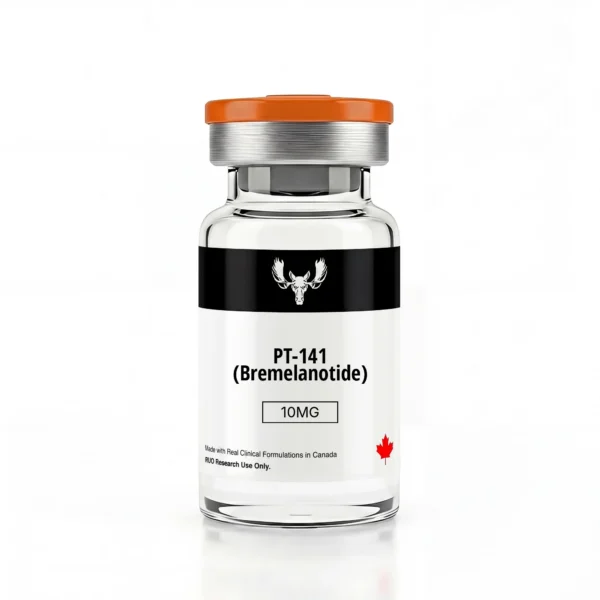
How PT-141 Enhances Sexual Health
PT-141 (Bremelanotide) is the most extensively researched peptide for sexual health, and the only peptide in this class to have completed Phase 3 clinical trials and received FDA approval — as Vyleesi, for hypoactive sexual desire disorder (HSDD) in premenopausal women. It is a synthetic analog of alpha-melanocyte-stimulating hormone (α-MSH) that activates melanocortin receptors MC3R and MC4R in the hypothalamus — the brain regions that directly regulate sexual motivation, arousal, and desire.
This central mechanism is what makes PT-141 uniquely valuable as a sexual health peptide in Canada. Viagra targets blood vessels. Hormone therapy targets the endocrine system. PT-141 targets the brain circuits that generate the desire for sexual activity in the first place — making it effective even when the hormonal and vascular systems are functioning normally but the neurological drive is absent. Research published in the Journal of Sexual Medicine confirmed PT-141’s effectiveness for HSDD in both pre- and post-menopausal women, significantly increasing sexual satisfaction scores versus placebo.
For men, the double-blind, placebo-controlled evaluation by Diamond et al. confirmed PT-141 could produce erections through central MC receptor activation without requiring sexual stimulation — a particularly important finding for men whose erectile dysfunction has a psychological or desire-based component rather than a purely vascular one.
Who PT-141 Is Most Useful For
- Women with HSDD — low desire not explained by relationship issues, medication, or medical conditions. The FDA-approved indication.
- Men with ED where desire is the primary issue — especially those unresponsive to or unsuitable for PDE5 inhibitors.
- Anyone whose hormones are balanced but desire remains absent — the “hormones are fine but I still feel nothing” scenario where the neurological layer is the gap.
- Post-menopausal women — the brain’s desire pathways remain intact after menopause; PT-141 can re-activate them even after the hormonal environment has changed.
Side Effects to Know
The most commonly reported side effect in clinical trials is nausea (~40% of users), followed by flushing (~20%) and headache (~10–15%). These are generally mild, dose-dependent, and resolve within a few hours. A transient blood pressure increase occurs post-injection — PT-141 is contraindicated in uncontrolled hypertension and cardiovascular disease. Skin darkening at the face or gums can occur with frequent use due to MC1R activation. The 52-week long-term safety study by Simon et al. confirmed no loss of efficacy over time and no serious adverse events requiring discontinuation in the majority of participants.
Shop PT-141 (Bremelanotide) 10mg →02 — Best Peptide for Bonding & Emotional Intimacy
Oxytocin (10mg)
The “Bonding Hormone” · Emotional Connection · Arousal Enhancement · Stress Reduction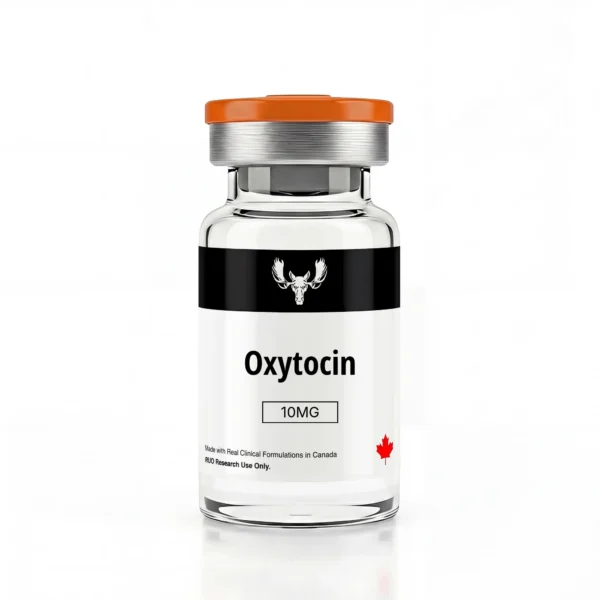
How Oxytocin Enhances Sexual Health
Oxytocin is one of the body’s own neuropeptides — a nine-amino-acid hormone produced in the hypothalamus and released by the pituitary gland. It’s often called the “bonding hormone” or “love hormone” because of its well-documented role in social bonding, trust, and emotional attachment. In the context of sexual health, it plays a distinct and complementary role to PT-141: where PT-141 activates the brain’s desire circuitry, Oxytocin deepens the emotional connection and safety that allow that desire to translate into genuine intimacy.
Oxytocin is naturally released during physical touch, orgasm, and breastfeeding. Chronic stress is one of the primary suppressors of natural oxytocin release — which is why stress-related reductions in libido and emotional disconnection from a partner often go together. Research has shown that oxytocin enhances sexual arousal response, improves orgasmic intensity, and reduces the anxiety and self-consciousness that can inhibit sexual expression. A study published in Hormones and Behavior (2015) found that intranasal oxytocin administration enhanced sexual arousal and partner bonding in healthy couples, suggesting a role both in initiating desire and sustaining the emotional satisfaction that makes intimacy rewarding over time.
Beyond desire itself, research has documented oxytocin’s role in improving orgasmic response — with studies suggesting it enhances the intensity and duration of orgasm by amplifying the neural feedback loop during climax. For researchers studying sexual dysfunction driven by emotional disconnection, relationship stress, anxiety, or the emotional flatness that often accompanies hormonal transitions, Oxytocin addresses a layer of sexual health that neither PT-141 nor any vascular medication covers.
Who Oxytocin Is Most Useful For
- Individuals with stress-driven libido reduction — chronic stress directly suppresses natural oxytocin release; supplementation can restore this signal.
- People experiencing emotional disconnection from a partner — Oxytocin’s bonding mechanism supports the emotional environment that underpins physical intimacy.
- Women during and after menopause — hormonal shifts reduce natural oxytocin sensitivity; supplementation can restore responsiveness.
- Anyone seeking to enhance orgasmic response — oxytocin’s role in intensifying climax is one of its most documented sexual health effects.
- Combined with PT-141 protocols — PT-141 activates desire; Oxytocin deepens connection. Together they address both the motivation and the emotional experience of intimacy.
Side Effects and Safety
Oxytocin has a well-established safety profile from decades of clinical use in obstetrics (where it is used to stimulate labour and manage postpartum hemorrhage). At the doses studied for sexual health and bonding research, it is generally well tolerated. The most commonly reported effects at intranasal doses are mild — transient headache, nausea, and nasal irritation (for nasal delivery routes). At subcutaneous doses used in research, injection site reactions are the most common adverse event. Because Oxytocin can affect blood pressure and uterine contractility, it should not be used during pregnancy outside a clinical setting.
Shop Oxytocin 10mg →PT-141 vs. Oxytocin: How They Differ and Why Both Matter
These two peptides for sexual health in Canada are not interchangeable — they work on different neurological systems and address different aspects of the same problem. Understanding the distinction helps clarify when each is appropriate and why combining them is a common research protocol.
| PT-141 (Bremelanotide) | Oxytocin | |
|---|---|---|
| Primary receptor | MC3R / MC4R (melanocortin receptors) | Oxytocin receptors (brain & peripheral) |
| Main effect | Activates desire, libido, sexual arousal | Enhances bonding, trust, emotional intimacy, orgasm |
| Works on | Hypothalamic arousal circuits (dopaminergic/melanocortinergic) | Social bonding pathways, anxiety reduction, orgasmic response |
| Best for | Low desire, HSDD, absent libido, erectile dysfunction (neurological) | Emotional disconnection, stress-driven low libido, improved orgasm |
| Clinical approval | FDA-approved as Vyleesi for HSDD in premenopausal women | Clinically used in obstetrics; research-stage for sexual health |
| Onset | 45–60 minutes post-injection, lasts 6–12 hours | 15–30 minutes (intranasal); 20–45 min (subcutaneous) |
| Primary side effect | Nausea (~40%), flushing (~20%) | Mild headache, nausea (generally well tolerated) |
Combining PT-141 and Oxytocin for Sexual Health Research
Because PT-141 and Oxytocin address different neurological layers of sexual health, they complement rather than overlap each other in research protocols. PT-141 activates the desire pathway — it generates the motivation for sexual activity. Oxytocin deepens the emotional experience of intimacy — trust, connection, and the quality of orgasmic response. Used together, they address the full neurological spectrum of sexual wellness that hormonal treatments and vascular medications leave unaddressed.
This is the rationale behind combined sexual wellness protocols seen in functional medicine research: PT-141 for the “ignition” of desire, Oxytocin for the depth of the experience. The two peptides for sexual health in Canada operate through entirely separate receptor systems — there is no mechanistic overlap or competitive binding — which makes the combination pharmacologically clean.
Sexual Health Peptides in Canada: Sourcing Standards
For injectable sexual health peptides in Canada, sourcing quality is the most important variable. Both PT-141 and Oxytocin are active at low doses through central mechanisms — meaning purity matters more than it does for some other research peptides, where a few percent of synthesis byproducts has minimal practical impact. A contaminated or misdosed batch of a centrally-acting peptide is both a research validity problem and a safety concern.
Both products from Boss Peptides are manufactured in Canada, verified at >99% purity by HPLC and mass spectrometry, and ship same-day. Independent third-party COAs are available on request. Use our Peptide Dosage Calculator for accurate reconstitution volumes and injection unit calculations at any target dose.
Frequently Asked Questions: Peptides for Sexual Health in Canada
What are the best peptides for sexual health in Canada?
The two best-researched peptides for sexual health in Canada are PT-141 (Bremelanotide) and Oxytocin. PT-141 is the only FDA-approved melanocortin peptide for sexual dysfunction, targeting MC3R/MC4R receptors in the brain to activate desire and arousal. Oxytocin is the body’s natural bonding hormone, supplemented to enhance emotional intimacy, reduce stress-driven libido suppression, and improve orgasmic response. Together they address the neurological and emotional layers of sexual health that hormonal and vascular treatments don’t cover.
Do peptides for sexual health work for both men and women?
Yes. PT-141 has been studied and shows efficacy in both women (HSDD — FDA-approved indication) and men (erectile dysfunction and low desire — research stage). Oxytocin’s bonding and arousal-enhancing effects are not sex-specific; the oxytocin receptor system operates similarly in both sexes. Both peptides address neurological pathways present in all adults, making them relevant research compounds for both male and female sexual health.
How is PT-141 different from Viagra for sexual health?
Viagra (sildenafil) blocks PDE5 in vascular smooth muscle, increasing blood flow to genital tissue in response to sexual stimulation — it addresses the physical mechanics of arousal but has no effect on desire. PT-141 acts on melanocortin receptors in the hypothalamus to generate sexual desire at the brain level — it doesn’t require existing arousal to initiate its effects. PT-141 is most useful when desire itself is absent; Viagra is most useful when desire is present but physical response is impaired.
Can Oxytocin improve libido?
Yes, though through a different mechanism than PT-141. Oxytocin doesn’t directly activate the arousal pathway — it reduces stress-driven inhibition of desire, enhances emotional bonding with a partner, and improves the quality and intensity of orgasmic response. For people whose low libido is driven primarily by stress, emotional disconnection, or anxiety around intimacy, Oxytocin addresses the root cause more directly than PT-141 alone.
Are peptides for sexual health in Canada legal?
Yes — both PT-141 and Oxytocin are sold legally in Canada as research chemicals. PT-141 holds FDA approval in the United States (as Vyleesi) but is not approved by Health Canada for therapeutic use. Oxytocin is used clinically in Canada in obstetrics but is not approved for sexual health indications. Both are available from Boss Peptides for research purposes only.
Can PT-141 and Oxytocin be used together?
Yes. They act through entirely separate receptor systems (melanocortin vs. oxytocin receptors) with no mechanistic overlap or competitive interaction. Combined protocols using both peptides are used in functional medicine sexual wellness research, with PT-141 addressing the desire/arousal layer and Oxytocin addressing the emotional bonding and orgasmic response layer.
The Bottom Line: Peptides for Sexual Health in Canada
Sexual health depends on more than hormones and blood flow. The neurological layer — the brain circuits that generate desire and the bonding chemistry that makes intimacy emotionally meaningful — is where conventional treatments fall short, and where peptides for sexual health in Canada offer something genuinely new.
PT-141 activates the melanocortin desire pathway with Phase 3 clinical trial data and FDA approval behind it. Oxytocin restores the bonding signal that stress and age suppress, deepening emotional connection and orgasmic response. Together they address the two neurological layers of sexual wellness that hormonal therapy, Viagra, and conventional treatments leave untouched.
Both are available from Boss Peptides — manufactured in Canada, >99% purity, same-day shipping across Canada. Shop PT-141 → | Shop Oxytocin → | Browse all peptides →