

Canadian Researcher Guide · 2026
PT-141 (Bremelanotide) in Canada: How It Works, Benefits, Side Effects & Where to Buy
PT-141, sold under the brand name Vyleesi, is the only FDA-approved melanocortin peptide for treating sexual dysfunction — specifically hypoactive sexual desire disorder (HSDD) in premenopausal women. Unlike PDE5 inhibitors like Viagra, which work on vascular tissue, PT-141 (Bremelanotide) acts directly on the central nervous system through melanocortin receptors in the brain. This guide covers how it works, what the research shows for both men and women, the full side effect profile from clinical trial data, dosing, and where to buy PT-141 in Canada for research purposes.
What Is PT-141 (Bremelanotide)?
PT-141 is a synthetic peptide analog of alpha-melanocyte-stimulating hormone (α-MSH), developed from the tanning peptide Melanotan 2. Its generic name is Bremelanotide. It activates melanocortin receptors — specifically MC3R and MC4R — in the hypothalamus and other brain regions involved in regulating sexual arousal and desire.
The FDA approved Bremelanotide (Vyleesi) in 2019 for treating HSDD in premenopausal women — making it the first and only approved melanocortin-based treatment for sexual dysfunction. Its mechanism is fundamentally different from existing sexual dysfunction medications, which typically work peripherally on blood vessels rather than centrally on desire pathways in the brain.
How PT-141 Works: The Melanocortin Mechanism
The melanocortin system is a network of peptide hormones and receptors distributed throughout the brain and body. In the context of sexual function, MC3R and MC4R receptors in the hypothalamus play a central role in regulating sexual motivation, arousal, and behaviour. PT-141 binds to these receptors and activates downstream dopaminergic and oxytocinergic pathways — effectively increasing the neurochemical signals associated with sexual desire.
This central mechanism is what makes PT-141 distinct. Rather than facilitating the physical response to arousal (as Viagra does), it activates the brain circuits that generate the motivation to seek sexual activity in the first place. Research published in Annals of the New York Academy of Sciences (Molinoff et al.) described PT-141 as “a melanocortin agonist for the treatment of sexual dysfunction” that produced sexual arousal through a central, non-vascular mechanism — confirmed in both animal models and early human trials.
The peptide’s half-life after subcutaneous injection is approximately 2–3 hours, with effects typically beginning 45 minutes to 1 hour post-injection and lasting 6–12 hours depending on the individual. Because it acts centrally, its effects are not dependent on physical stimulation or the timing of a sexual encounter in the same way that blood-flow-based medications are.
PT-141 Benefits: What the Research Shows
For Women: HSDD and Sexual Desire
The strongest evidence for PT-141 is in premenopausal women with HSDD — the condition that earned it FDA approval. The Phase 3 RECONNECT trials enrolled women diagnosed with HSDD and compared Bremelanotide to placebo over 24 weeks. The trials measured two co-primary endpoints: a patient-reported desire score and a distress score related to low sexual desire.
Both endpoints improved significantly in the Bremelanotide group compared to placebo. Participants reported more satisfying sexual events, reduced distress related to low desire, and improved overall sexual function. The long-term safety and efficacy study by Simon et al. confirmed these effects were maintained over 52 weeks of continued use, with no development of tolerance to the drug’s efficacy — though some research has noted the potential for melanocortin receptor desensitisation with long-term high-frequency use.
For Men: Erectile Dysfunction Research
While PT-141’s FDA approval is specifically for women, it has been studied extensively in men with erectile dysfunction. A double-blind, placebo-controlled evaluation by Diamond et al. tested intranasal PT-141 in healthy males and patients with mild-to-moderate erectile dysfunction. The compound produced erections in both groups through the central melanocortin pathway — without requiring sexual stimulation. Importantly, this was achieved without the cardiovascular effects associated with PDE5 inhibitors, suggesting a potentially safer option for men who cannot use sildenafil or tadalafil due to cardiovascular contraindications.
Multiple subsequent studies have confirmed that PT-141 can produce penile erection in men through MC receptor activation in the hypothalamus, with the effect beginning roughly 45–60 minutes after injection. For men who have erectile dysfunction driven by psychological factors (reduced desire, performance anxiety) rather than purely vascular causes, PT-141’s central mechanism addresses the root pathway more directly than blood-flow medications.
Beyond Sexual Dysfunction: Emerging Research
PT-141’s melanocortin receptor activity has also generated research interest in adjacent areas. Melanocortin receptors are involved in inflammation regulation, energy metabolism, and pain modulation — which is why some researchers have studied PT-141 in the context of inflammatory conditions and chronic pain. These applications remain early-stage and outside the compound’s approved indication, but they reflect the breadth of the melanocortin system’s biological roles.
Full Side Effect Profile
The side effect data for PT-141 is well-characterised from the Phase 3 trials and the Mayo Clinic’s compiled clinical data for Bremelanotide. Understanding these is important for any research protocol.
Nausea Management
Nausea is the side effect most likely to affect research protocol adherence. In clinical practice, pre-medication with an antiemetic (anti-nausea medication) before injection has been used to manage this. The nausea is dose-dependent and tends to be most pronounced at first use, often decreasing with subsequent doses as the body adjusts. Avoiding food for 2 hours before injection also reduces severity in some individuals.
Skin Darkening (Hyperpigmentation)
Because PT-141 activates MC1R in addition to MC3R/MC4R, it can stimulate melanin production — the same mechanism behind tanning peptides. The Mayo Clinic’s Bremelanotide documentation specifically flags darkening of the face, gums, or breasts as a less common side effect, particularly with daily use and in individuals with darker baseline skin tone. This is not harmful but is cosmetically relevant and should be considered in research protocols involving extended use.
Blood Pressure
PT-141 produces a transient, dose-dependent increase in blood pressure after injection, typically peaking within 12 hours and resolving without intervention. The Mayo Clinic contraindications specifically exclude patients with uncontrolled hypertension and cardiovascular disease from Bremelanotide use. For research purposes, baseline and post-injection blood pressure monitoring is standard protocol.
Drug Interactions
PT-141 delays gastric emptying — which can affect the absorption of orally administered medications taken around the same time. The interaction with naltrexone (an opioid antagonist) is specifically flagged because melanocortin and opioid receptor systems interact; this combination is generally not recommended. Any research subject taking oral medications should be assessed for potential absorption interference.
Dosing: What the Clinical Data Uses
The FDA-approved dosing for Bremelanotide (Vyleesi) for HSDD is 1.75 mg subcutaneously injected at least 45 minutes before anticipated sexual activity. The approved protocol allows no more than one dose in 24 hours and no more than 8 doses per month. Injection sites are rotated between the abdomen and thighs.
In the male erectile dysfunction research, intranasal and subcutaneous routes have both been studied at similar dose ranges. Research protocols outside the HSDD indication have explored doses from 1 mg to 2 mg subcutaneously, with onset typically 45–60 minutes post-injection and duration of 6–12 hours.
PT-141 is available at 10mg per vial from Boss Peptides — providing sufficient material for multiple research administrations at standard dose ranges. Use our Peptide Dosage Calculator for precise reconstitution volumes.
PT-141 (Bremelanotide) (10mg) — Research Grade, Canadian Manufactured
Research Chemical · Canadian Manufactured
PT-141 (Bremelanotide) (10mg)
MC3R / MC4R Agonist · FDA-Approved Mechanism · >99% Purity · Ships Same-Day Canada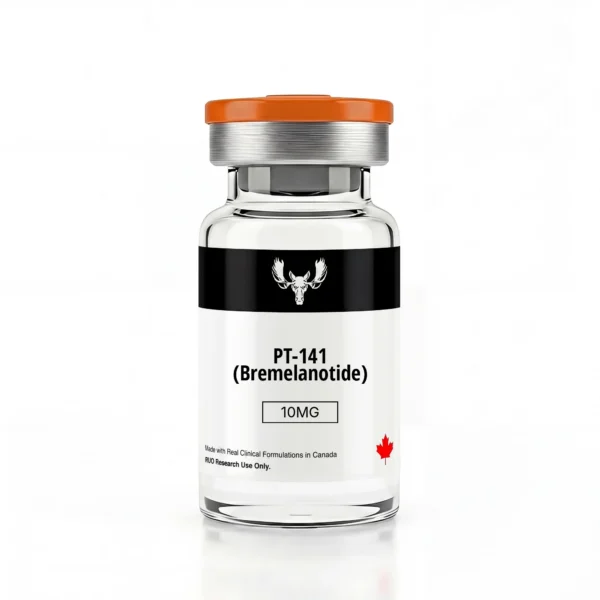
Product Overview
Our PT-141 (Bremelanotide) (10mg) is manufactured in Canada, verified at >99% purity by HPLC and mass spectrometry, and ships same-day. At 10mg per vial, it provides a meaningful supply for research protocols studying melanocortin receptor pharmacology, sexual function biology, or the central nervous system mechanisms underlying arousal and desire.
PT-141 is the only peptide in the melanocortin class with FDA approval for a therapeutic indication — Vyleesi for HSDD — which gives it a stronger human clinical data record than most research peptides. The Phase 3 RECONNECT trials and the long-term safety data by Simon et al. (52 weeks) provide well-characterised efficacy and safety parameters that researchers can reference directly.
The 10mg vial provides approximately 5–10 doses at the 1–2mg range studied in clinical research. Reconstitute with bacteriostatic water and store refrigerated after reconstitution. For injection unit calculations and reconstitution volumes at any target dose, use our Peptide Dosage Calculator.
Key Research Applications
- Melanocortin receptor (MC3R/MC4R) pharmacology and central arousal pathway research
- Sexual dysfunction biology — both HSDD in women and erectile dysfunction in men
- Comparison with peripheral mechanisms (PDE5 inhibition) — central vs. vascular arousal pathways
- Melanocortin system’s role in inflammation, energy metabolism, and pain modulation
- FDA-approved mechanism with Phase 3 human trial data — the most clinically validated melanocortin peptide available
PT-141 vs. PDE5 Inhibitors: Understanding the Difference
The comparison between PT-141 and medications like Viagra or Cialis comes up frequently, and it’s worth being precise because the mechanisms are genuinely different — not just different routes to the same outcome.
PDE5 inhibitors work by blocking phosphodiesterase type 5, an enzyme that breaks down cyclic GMP in vascular smooth muscle. By preserving cyclic GMP, they allow blood vessels in genital tissue to dilate in response to sexual stimulation — facilitating the physical response. They require sexual stimulation to work, they act peripherally on vascular tissue, and they carry cardiovascular contraindications because of their blood pressure effects.
PT-141 works in the brain, not the vasculature. It activates MC3R/MC4R receptors in the hypothalamus, promoting the neurochemical signalling pathways — particularly dopaminergic and oxytocinergic — that generate sexual desire and motivation. It doesn’t require existing sexual stimulation to initiate its effects; it acts on the upstream brain processes that generate the desire for stimulation in the first place. This is why it has utility in HSDD (where physical response is intact but desire is absent) and why it’s studied separately from vascular sexual dysfunction medications.
Contraindications and Who Should Not Use PT-141
Based on the Mayo Clinic’s clinical summary and the FDA prescribing information, PT-141/Bremelanotide is contraindicated or requires particular caution in the following situations:
Uncontrolled hypertension or cardiovascular disease — PT-141 produces transient blood pressure increases post-injection. This is specifically listed as a contraindication for Vyleesi by the FDA.
Severe kidney or liver disease — Reduced clearance of the peptide can increase exposure and side effect severity.
Pregnancy — The Mayo Clinic recommends using effective contraception during use, as Bremelanotide may harm a developing fetus. The compound can remain in the system for some time after use.
Concomitant naltrexone use — The melanocortin/opioid receptor interaction makes this combination generally inadvisable.
Slow gastric emptying conditions — PT-141 delays gastric emptying, which can worsen existing GI motility conditions and reduce absorption of co-administered oral medications.
Frequently Asked Questions About PT-141 in Canada
What is PT-141 used for?
PT-141 (Bremelanotide) is FDA-approved for treating hypoactive sexual desire disorder (HSDD) in premenopausal women. It has also been studied extensively for erectile dysfunction in men. It works by activating melanocortin receptors (MC3R/MC4R) in the brain to enhance sexual desire and arousal through a central nervous system mechanism, rather than through vascular effects like Viagra.
How is PT-141 different from Viagra?
Viagra (sildenafil) works peripherally — it increases blood flow to genital tissue in response to sexual stimulation by blocking PDE5 in vascular smooth muscle. PT-141 works centrally — it activates melanocortin receptors in the hypothalamus to enhance sexual desire and motivation at the brain level. PT-141 doesn’t require existing arousal to initiate its effects, and it’s effective for conditions where desire itself is impaired rather than just the physical response.
What are the most common PT-141 side effects?
The most common side effects are nausea (~40% of users), flushing (~20%), and headache (~10–15%). Injection site reactions are also common. Less frequently: dizziness, vomiting, joint pain, skin darkening at face or gums with extended use, and transient blood pressure elevation. Side effects are generally mild to moderate and resolve within a few hours. Nausea is the most likely to affect protocol adherence and can be managed with antiemetics.
How long does PT-141 take to work?
Onset is typically 45 minutes to 1 hour after subcutaneous injection. The FDA-approved protocol for HSDD specifies injecting at least 45 minutes before anticipated sexual activity. Effects can last 6–12 hours depending on individual response and dose.
Is PT-141 approved in Canada?
Bremelanotide (Vyleesi) holds FDA approval in the United States for HSDD in premenopausal women. In Canada, it is not currently approved by Health Canada for therapeutic use and is sold as a research chemical. It has the most robust human clinical data of any melanocortin peptide, with Phase 3 trial data and 52-week long-term safety data available from published literature.
Can PT-141 be used by men?
Yes — PT-141 has been studied in men for erectile dysfunction, with the double-blind research by Diamond et al. confirming it can produce erections through central melanocortin receptor activation without requiring sexual stimulation. It is not FDA-approved for male sexual dysfunction specifically, but the mechanism applies to both sexes since MC3R/MC4R receptors regulate sexual arousal pathways in both men and women. For research purposes, our 10mg vial covers both research contexts.
The Bottom Line on PT-141 in Canada
PT-141 (Bremelanotide) stands apart from most research peptides because it has gone all the way through Phase 3 clinical trials and received FDA approval — making its efficacy and safety profile better documented than almost any other peptide in this class. The central melanocortin mechanism is genuinely different from existing sexual dysfunction medications, which is why it fills a clinical gap for conditions where desire itself is impaired rather than just the physical response.
The side effect profile is manageable but real — nausea affects roughly 40% of users and is the primary tolerability concern. Blood pressure monitoring is standard practice given the transient cardiovascular effects. These are the same considerations documented in the FDA prescribing information for Vyleesi, applied to a research context.
For researchers in Canada studying melanocortin receptor pharmacology, central arousal pathways, or sexual dysfunction biology, PT-141 (Bremelanotide) (10mg) from Boss Peptides is manufactured domestically at >99% purity with same-day shipping and COAs on every batch.